Introduction
The dream of moving to Spain is a powerful one, built on visions of a sun-drenched lifestyle, rich culture, and a significantly lower cost of living. For thousands of aspiring expats, it represents a chance to slow down and enjoy a higher quality of life.
However, the path to Spanish residency is paved with bureaucracy, and the rules of the road are a constantly shifting landscape. Common knowledge and advice from even a year ago can be dangerously outdated, leading to failed applications and shattered plans. Success requires navigating this system with current, accurate information.
This article reveals five of the most surprising, counter-intuitive, and impactful truths about the Spanish visa system that prospective expats must understand before they make their move.
Here are the five truths you need to accept before you start your search.
The “Golden Visa” Is Gone: The End of an Era for Investors
Spain’s Golden Visa program is officially closed to new applicants. While applications submitted before April 3, 2025, will be processed, no new applications based on real estate or other investments are being accepted beyond that date.
For years, this was the most famous path to residency for affluent non-EU citizens. The strategy was simple: purchase at least €500,000 worth of property and gain the right to live in Spain. This popular and straightforward route is now gone. Any advice centered on buying a high-value property to secure a visa is incorrect for new applicants.
This pivot signals a deliberate shift by Spain away from investment-based residency, forcing prospective expats to demonstrate their value through professional skills, remote work, or proven self-sufficiency. The primary alternatives to consider are now the Non-Lucrative Visa, the Digital Nomad Visa, or a traditional Work Visa.
The Non-Lucrative Visa: More Flexible Than Ever, But With Stricter Audits
The Non-Lucrative Visa (NLV), designed for retirees and those with passive income, has undergone a dramatic transformation, offering both new freedom and formidable new hurdles.
The most significant positive change is that the NLV is now granted with a 365-day validity for entry. This replaces the old, restrictive 3-month window, giving you a full year to plan your move. Critically, your one-year residency period begins on the first day you enter Spain, offering incredible flexibility for timing your relocation.
However, this convenience comes at the cost of intense new scrutiny:
Deep Financial Audits: Consulates now demand much more than a simple bank balance. You must provide 12 months of bank statements and often the last three years of tax returns. They are scrutinizing transfers between accounts and may demand proof of how you earned your funds to verify the money is “legal and is not coming from loans.”
Mandatory Residency for Renewal: A major legislation change effective from the 20th of May 2025 mandates that to renew an NLV, you must prove you have spent at least 183 days per calendar year in Spain. This makes you a tax resident and is a non-negotiable requirement.
Strict Family Limitations: Adult parents and children 18 or older can no longer be included as dependents. They must now qualify on their own by meeting the full financial requirements individually.
The takeaway is clear: Spain is trading flexibility on entry timing for non-negotiable proof of financial legitimacy and a commitment to becoming a full-time, tax-paying resident.
The Best Path for Entrepreneurs Is Not the “Entrepreneur Visa”
This is one of the most counter-intuitive truths of Spanish immigration. The official “Self-Employment Visa” seems like the logical choice for starting a business, but it’s an exceptionally long and uncertain process. The critical step—getting your business plan approved—has no official turnaround time and can take anywhere from six months to a year, leaving your plans in bureaucratic limbo.
A much faster and more predictable route exists. The “shortcut” involves first obtaining a Non-Lucrative Visa. After residing in Spain for one year, you can apply for a “modification” to work as self-employed.
The key benefit is time. The business plan approval for this modification process has a mandated response time of just three months. This makes it a significantly faster and more reliable strategy for launching a business in Spain compared to the uncertainty of the direct self-employment visa.
The Popular Student Visa “Loophole” Has Been Closed
For years, the student visa was a popular and flexible back door into Spain, especially for those pursuing non-degree studies like intensive language courses. People of all ages would enroll, live in the country, and later modify their status to a work visa. Recent changes have slammed this door shut, specifically for non-higher education students.
The new restrictions for language students and similar programs are severe:
Applications must be made from the consulate in your home country; you can no longer apply from within Spain while on a tourist visa.
The total time allowed on this type of student visa is now capped at two years.
Crucially, it is no longer possible to modify this visa to a work visa.
Family members can no longer be brought along as dependents.
These changes have eliminated a well-trodden, low-cost exploratory pathway into long-term residency. While students pursuing university degrees (Master’s, PhD) are largely unaffected by these specific closures, those hoping to use a language course as a stepping stone must now have a much more limited plan.
“I’m surprised that why would you not want smart people who are here you know learning Spanish to then be able to stay particularly in a situation where the country is looking for working age migrants who can come here and contribute to the economy.”
The Hidden Cost of a Spanish Passport: Your US Citizenship
For many Americans, gaining a European passport is the ultimate long-term goal. However, there is a profound and often-overlooked requirement. After five years of continuous legal residency, one can apply for permanent residency. After holding permanent residency for five more years (totaling ten years in Spain), US citizens become eligible to apply for citizenship.
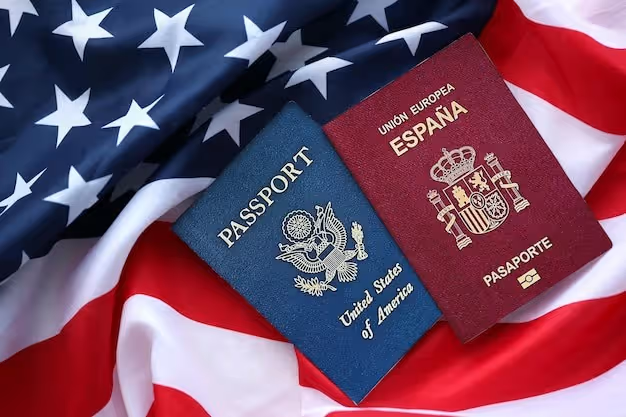
At that point, to obtain a Spanish passport, a US citizen must renounce their American citizenship.
Spain only recognizes dual citizenship with a select list of countries, such as France, Portugal, and certain Latin American nations. The United States is not on this list. For many who dream of becoming a Spanish and EU citizen, this is a monumental decision with serious long-term consequences that requires consideration years in advance.